Sunday, February 8, 2015
Black History Month 2015 - The Harlem Renaissance - A. Philip Randolph
I had started the personalities portion of this series with Josephine Baker, but after looking at the HUGE list of names at the bottom of the Wikipedia article on the Harlem Renaissance, I was intrigued by the category "Leading Intellectuals" and decided to look at who those people were. The first in this sub-series is A. Philip Randolph.
~~~
From Wikipedia:
Asa Philip Randolph (April 15, 1889 – May 16, 1979) was a leader in the African-American civil-rights movement, the American labor movement, and socialist political parties.
He organized and led the Brotherhood of Sleeping Car Porters, the first predominantly African American labor union. In the early civil-rights movement, Randolph led the March on Washington Movement, which convinced President Franklin D. Roosevelt to issue Executive Order 8802 in 1941, banning discrimination in the defense industries during World War II. The group then successfully pressured President Harry S. Truman to issue Executive Order 9981 in 1948, ending segregation in the armed services.
In 1963, Randolph was the head of the March on Washington, which was organized by Bayard Rustin, at which Reverend Martin Luther King, Jr. delivered his "I Have A Dream" speech. Randolph inspired the Freedom budget, sometimes called the "Randolph Freedom budget", which aimed to deal with the economic problems facing the black community.
~~~
I am somewhat sad to say that I don't recall ever knowing about A. Philip Randolph. I am sure that in all the many documentaries I have watched over the decades about the civil rights movement, that his name surely must have come up, but reading the wiki it was all new to my memory. I found it interesting that before he was an activist he had aspired to be an actor but let it go because his parents didn't approve. Instead he took that charisma and channeled it into motivating others to social change. I think even as an actor, he probably would still have been motivated to political action for labor organization and human rights in addition to his theater and/or movie career.
Saturday, February 7, 2015
Black History Month 2015 - The Harlem Renaissance - Josephine Baker
![]() |
| Josephine Baker (image source: http://abcnews.go.com/Politics/top-spies-suspect/story?id=15528916) |
When I was doing the Black History posts on WordPress, I usually had a particular individual that I focused on. This time I was so fascinated by the back story of the whole Harlem Renaissance that I felt I had to include it in the total series. Today I am going to start looking at the notable individuals of the era. The first individuals I wanted to focus on I alluded to in the prior entry about music and fashion. For this year I originally intended to do multiple eras of Black arts, but with the myriad of talent from the Harlem Renaissance I may not get to the others!
To start off this sub-series I would like to look at the amazing Josephine Baker. I of course include a link to a video of the famous Banana Dance at the end.
~~~
From Wikipedia:
Josephine Baker (June 3, 1906 – April 12, 1975) was an American-born French dancer, singer, and actress who came to be known in various circles as the "Black Pearl," "Bronze Venus" and even the "Creole Goddess". Born Freda Josephine McDonald in St. Louis, Missouri, Josephine later became a citizen of France in 1937. She was fluent in both English and French.
Baker was the first black woman to star in a major motion picture, Zouzou (1934) or to become a world-famous entertainer. Baker, who refused to perform for segregated audiences in America, is also noted for her contributions to the Civil Rights Movement. She was once offered unofficial leadership in the movement in the United States by Coretta Scott King in 1968, following Martin Luther King, Jr.'s assassination. Baker, however, turned down the offer. She was also known for assisting the French Resistance during World War II, and received the French military honor, the Croix de guerre and was made a Chevalier of the Légion d'honneur by General Charles de Gaulle.
~~~
Josephine Baker is one of those legendary figures that most people have at least heard the name even if they don't know the whole story. I don't even remember when I first heard of her but the only thing I knew was the banana skirt and that she was a dancer (I assumed burlesque based om the outfit).
She is so much more than the iconic comedic seduction! It is incredible that she was an instrumental figure in her new home of France during WWII. Her refusal to perform in segregated venues may have stifled her career in the USA but didn't stop her from becoming an international star in the end with a career that spanned over 50 years.
As promised, here is a link, to a short bit of the infamous banana dance: https://www.youtube.com/watch?v=TG4kG79YpUQ
~~~
More videos:
https://www.youtube.com/watch?v=C_Y7_J3U-_I (Don't Touch My Tomatoes performance)
https://www.youtube.com/watch?v=6BhNv7dRHQI (a short segment about her with great footage)
Sketchbook Saturday
This is a 1989 self portrait of me in my prom dress and the actual jewelry that I wore. While the other girls were spending hundreds of dollars trying to look like a Disney princess, I got a cute little cocktail style dress on sale for only $35! The jewelry was vintage costume that my grandmother gave me a few years prior. The shoes were basic Payless Shoe Source and I think I got the stockings from there too. Notice that I didn't draw my hands. I still hate to draw hands!
Friday, February 6, 2015
Black History Month 2015 - The Harlem Renaissance - Music and Fashion
![]() |
| Image source: http://www.ourvalleyvoice.com/2014/02/20/black-history-committee-plans-harlem-renaissance-celebration/ |
Thanks for joining me in the continuation of the Black History Month series on the Harlem Renaissance. This time we will look at the music. Links to examples from YouTube are at the bottom of the entry.
~~~
From the Wikipedia article on the Harlem Renaissance:
![]() |
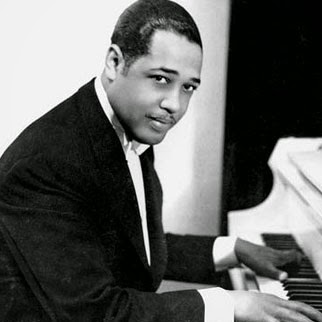
| Duke Ellington |
During this period, the musical style of blacks was becoming more and more attractive to whites. White novelists, dramatists and composers started to exploit the musical tendencies and themes of African–Americans in their works. Composers used poems written by African-American poets in their songs, and would implement the rhythms, harmonies and melodies of African-American music—such as blues, spirituals, and jazz—into their concert pieces. Negroes began to merge with Whites into the classical world of musical composition. The first Negro male to gain wide recognition as a concert artist in both his region and internationally was Roland Hayes. He trained with Arthur Calhoun in Chattanooga, and at Fisk University in Nashville. Later, he studied with Arthur Hubbard in Boston and with George Henschel and Amanda Ira Aldridge in London, England. He began singing in public as a student, and toured with the Fisk Jubilee Singers in 1911.
During the Harlem Renaissance, Black America’s clothing scene took a dramatic turn from the prim and proper. African-Americans wore clothing that was far from somber. Women were dressed in wide hats garlanded with flowers, modest veils, silk stockings that were held up by garters, open-toed slippers, and the low-slung dress, possibly with a ribbon at the hip. Though the 1920s cloche, a close-fitting number usually made of felt or wool, was extremely popular for casual wear and was worn gaily pulled down over the eyes. Popular by the 1930s was the trendy beret hat with stand-up or egret feather. Men wore zoot suits which were wide-legged, high-waisted, pegged trousers, and a long coat with wide padded shoulders and lapels. They also wore wide-brimmed hats, hand-colored socks, white gloves, and velvet-collared Chesterfield coats. African Americans also expressed respect for their heritage through a style of leopard-skin coats indicating the great power of the infamous African animal.
~~~
I chose the image of the Cotton Club for the first picture because no matter how one may feel in retrospect about the white gang affiliation of some of the better clubs in Harlem, one can't deny the iconic nature of this particular venue. I admit my introduction to this place was the 1984 movie which I haven't watched since back then so I barely remember it now.I went through a jazz phase in the late 90s early 2000s after a decade of only listening to gospel. I owned all the classics. My favorite of course was Billie Holliday. There is something deeply moving about the music from this particular era. From the jump and shout big band to the haunting solo singers, the music captures so much of who we were at the time like a window into the past.
~~~
YOUTUBE:
Fats Waller -- https://www.youtube.com/watch?v=in1eK3x1PBI
Duke Ellington -- https://www.youtube.com/watch?v=qDQpZT3GhDg
Jelly Roll Morton -- https://www.youtube.com/watch?v=CIerJMCK5_E
Willie "The Lion" Smith -- https://www.youtube.com/watch?v=KDMOkgSdy3E (from the 1960s)
Roland Hayes -- https://www.youtube.com/watch?v=b8NGQGIogys
Billie Holliday -- https://www.youtube.com/watch?v=h4ZyuULy9zs
Cab Calloway -- https://www.youtube.com/watch?v=_8yGGtVKrD8 (from 1943)
~~~
IMAGE SOURCES:
Duke Ellington - http://wdim.aiwdepts.com/studentWork/IMD110/Jesse_Vargas/music.htm)
Roland Hayes - http://www.georgiaencyclopedia.org/articles/arts-culture/roland-hayes-1887-1977
Cab Calloway - http://pixgood.com/cab-calloway-zoot-suit.html
Billie Holliday - http://en.wikipedia.org/wiki/Billie_Holiday
Thursday, February 5, 2015
Black History Month 2015 - The Harlem Renaissance - Religion
![]() |
| Image source: http://social.rollins.edu/wpsites/mosaic-hurston/2011/07/12/the-harlem-renaissance-a-social-documentary-through-art/ (Palmer C. Hayden, Midsummer Night in Harlem, 1938, oil on canvas) |
Still working my way through the Harlem Renaissance. This time is a look at the influence of religion on the era.
~~~
From the Wikipedia article on the Harlem Renaissance:
![]() |
| image source pbs.org |
Christianity played a major role in the Harlem Renaissance. Many of the writers and social critics discussed the role of Christianity in African–American lives. For example, a famous poem by Langston Hughes, "Madam and the Minister", reflects the temperature and mood towards religion in the Harlem Renaissance. The cover story for The Crisis Magazine′s publication in May 1936 explains how important Christianity was regarding the proposed union of the three largest Methodist churches of 1936. This article shows the controversial question about the formation of a Union for these churches. The article "The Catholic Church and the Negro Priest", also published in the Crisis Magazine, January 1920, demonstrates the obstacles African–American priests faced in the Catholic Church. The article confronts what it saw as policies based on race that excluded African–Americans from higher positions in the church.
Various forms of religious worship existed during this time of African–American intellectual reawakening. Although there were racist attitudes within the current Abrahamic religious arenas many African–Americans continued to push towards the practice of a more inclusive doctrine. For example, George Joseph MacWilliam presents various experiences, during his pursuit towards priesthood, of rejection on the basis of his color and race yet he shares his frustration in attempts to incite action on part of The Crisis Magazine community.
There were other forms of spiritualism practiced among African–Americans during the Harlem Renaissance. Some of these religions and philosophies were inherited from African ancestry.
For example, the Islam religion was present in Africa as early as the 8th century through the Trans-Saharan trade. Islam came to Harlem likely through the migration of members of the Moorish Science Temple of America, which was established in 1913 in New Jersey.
Various forms of Judaism were practiced, such as Orthodox Judaism and Masorti Judaism and even Reformed Judaism, but it was Black Hebrew Israelites that founded their religious belief system during the late 20th century in the Harlem Renaissance.
Traditional forms of religion acquired from various parts of Africa were inherited and practiced during this era. Some commons examples were Voodoo and Santeria.
Religious critique during this era was found in literature, art, and poetry. The Harlem Renaissance encouraged analytic dialogue that included the open critique and the adjustment of current religious ideas.
![]() |
| Aaron Douglas (Image source: convozine.com) |
One of the major contributors to the discussion of African–American renaissance culture was Aaron Douglas who, with his artwork, also reflected the revisions African Americans were making to the Christian dogma. Douglas uses biblical imagery as inspiration to various pieces of art work but with the rebellious twist of an African influence.
![]() |
| Countee Cullen (image source www.poets.org) |
Countee Cullen’s poem “Heritage” expresses the inner struggle of an African American between his past African heritage and the new Christian culture. A more severe criticism of the Christian religion can be found Langston Hughes’ poem “Merry Christmas", where he exposes the irony of religion as a symbol for good and yet a force for oppression and injustice.
~~~
My religious beginnings were not via a Black church so I was not introduced to the divisive history of the Church. I accepted Christ at a bible camp that was through a (predominantly white) church that I wasn't a member of (a man came to one of my high school classes to talk about the youth group).
I started attending church regularly in 1992 when I was a guest at the "Soul" service on the Davis Monthan air force base in Tucson, Arizona. It was then that my education in modern religious segregation began. I was also looking more into my Black heritage and part of that was how spiritualism played a huge part in the lives of my ancestors and their peers and how they adapted to the new way of expressing it that was given to them by their captors and masters.
There are many who reject the "slave master's religion" but it has been a huge part of how Negros were able to connect socially. (I use the term "Negro" to mean before we started calling ourselves "Black"). Even in the 20th century when I was active in church, I could see how this bond (whether Christian or another organized religion) could mean so much in defining our communities and creating a somewhat safe place for us to express ourselves on a different level.
Wednesday, February 4, 2015
Black History Month 2015 - The Harlem Renaissance - Mainstream Recognition
![]() |
| A Great Day In Harlem (image source: https://www.youtube.com/watch?v=D9n2PXO0qIU) |
Today we continue the examination of the Harlem Renaissance. This part is the mainstream recognition of Harlem culture.
~~~
From the Wikipedia article on the Harlem Renaissance:
![]() |
| Poet Claude McKay (image source wikimedia) |
The first stage of the Harlem Renaissance started in the late 1910s. In 1917, the premiere of Three Plays for a Negro Theatre took place. These plays, written by white playwright Ridgely Torrence, featured African-American actors conveying complex human emotions and yearnings. They rejected the stereotypes of the blackface and minstrel show traditions. James Weldon Johnson in 1917 called the premieres of these plays "the most important single event in the entire history of the Negro in the American Theater". Another landmark came in 1919, when the poet Claude McKay published his militant sonnet, "If We Must Die," which introduced a dramatically political dimension to the themes of African cultural inheritance and modern urban experience featured in his 1917 poems "Invocation" and "Harlem Dancer" (published under the pseudonym Eli Edwards, these were his first appearance in print in the United States after immigrating from Jamaica). Although "If We Must Die" never alluded to race, African-American readers heard its note of defiance in the face of racism and the nationwide race riots and lynchings then taking place. By the end of the First World War, the fiction of James Weldon Johnson and the poetry of Claude McKay were describing the reality of contemporary African-American life in America.
![]() |
| Hubert Harrison, "The Father of Harlem Radicalism" (image source wikimedia) |
In 1917 Hubert Harrison, "The Father of Harlem Radicalism", founded the Liberty League and The Voice, the first organization and the first newspaper, respectively, of the "New Negro Movement". Harrison's organization and newspaper were political, but also emphasized the arts (his newspaper had "Poetry for the People" and book review sections). In 1927, in the Pittsburgh Courier, Harrison challenged the notion of the renaissance. He argued that the "Negro Literary Renaissance" notion overlooked "the stream of literary and artistic products which had flowed uninterruptedly from Negro writers from 1850 to the present", and said the so-called "renaissance" was largely a white invention.
![]() |
| Writer James Weldon Johnson (image source wikimedia) |
The Harlem Renaissance grew out of the changes that had taken place in the African-American community since the abolition of slavery, as well as the expansion of communities in the North. These accelerated as a consequence of World War I and the great social and cultural changes in early 20th-century United States. Industrialization was attracting people to cities from rural areas and gave rise to a new mass culture. Contributing factors leading to the Harlem Renaissance were the Great Migration of African Americans to northern cities, which concentrated ambitious people in places where they could encourage each other, and the First World War, which had created new industrial work opportunities for tens of thousands of people. Factors leading to the decline of this era include the Great Depression.
~~~
I don't know about you, but I find this entire subject completely fascinating. It may be because I am an artist and a poet and a Black woman. This speaks to so many parts of me! As I look at this information I can't help but take a mental time travel trip and imagine being alive and Black in an era when there were still people alive who were formerly slaves. I know that the very air was charged with a residual racism from when we were less than human for CENTURIES. To be a Negro intellectual must have felt like revolution in and of itself.
I have really been enjoying going over the information for this series. I sincerely hope you are enjoying the process with me. Thanks for reading!
Tuesday, February 3, 2015
Black History Month 2015 - The Harlem Renaissance - Background of Harlem
![]() |
| Image source: http://upload.wikimedia.org/wikipedia/commons "Black Belt" by Archibald Motley |
Another day in Black History Month means another post about the Harlem Renaissance! There is so much on this one era that I think this will be the only one I cover and I'll save the other ones for next time.
~~~
From the Wikipedia article on the Harlem Renaissance:
During the early portion of the 20th century, Harlem was the destination for immigrants from around the country, attracting both people seeking work from the South, and an educated class who made the area a center of culture, as well as a growing "Negro" middle class. The district had originally been developed in the 19th century as an exclusive suburb for the white middle and upper middle classes; its affluent beginnings led to the development of stately houses, grand avenues, and world-class amenities such as the Polo Grounds and the Harlem Opera House. During the enormous influx of European immigrants in the late 19th century, the once exclusive district was abandoned by the white middle class, who moved further north.
Harlem became an African-American neighborhood in the early 1900s. In 1910, a large block along 135th Street and Fifth Avenue was bought by various African-American realtors and a church group. Many more African–Americans arrived during the First World War. Due to the war, the migration of laborers from Europe virtually ceased, while the war effort resulted in a massive demand for unskilled industrial labor. The Great Migration brought hundreds of thousands of African Americans to cities such as Chicago, Philadelphia, Detroit, and New York.
Despite the increasing popularity of Negro culture, virulent white racism, often by more recent ethnic immigrants, continued to affect African-American communities, even in the North. After the end of World War I, many African-American soldiers—who fought in segregated units such as the Harlem Hellfighters—came home to a nation whose citizens often did not respect their accomplishments. Race riots and other civil uprisings occurred throughout the US during the Red Summer of 1919, reflecting economic competition over jobs and housing in many cities, as well as tensions over social territories.
~~~
I'll be honest, before starting this series I only had a passing knowledge of Harlem at all let alone the Harlem Renaissance. I have found the background of the area as interesting as if I focused on the people of the era like I have done in the past on my WordPress blog.
Subscribe to:
Posts (Atom)